Your Ad Budget Has No Adult Supervision. It Threw a Party on Your Credit Card.
November 6, 2026
For small businesses running paid search and social, two questions matter most: is the money going out on schedule, and is it bringing anything back.
It's the 19th of the month. You run a landscaping company or a dental practice, and between payroll and a supplier call you remember to check your ads. Google Ads shows $2,900 spent against a $3,000 monthly search budget. Meta has barely touched half of its $2,000.
Together, they mean one channel has been running hot for two weeks, the other cold, and you found out by accident.
That is the reality for most small businesses spending around $5,000 a month on digital ads. The money is real. The attention is limited. And the two questions that matter most, whether the budget is pacing correctly and whether it is producing results, usually get answered late or not at all.
Pacing Is the Problem Nobody Watches
Budget pacing means spending your money at the rate you planned. If you set $5,000 for the month, you should be near $2,500 by the 15th. Simple in theory. Hard in practice, because ad platforms do not spend evenly.
Google Ads can spend up to twice your average daily budget on a given day. Meta's daily budgets flex too. A holiday weekend or a competitor pausing their ads can push spend up fast.
Underspending is the quieter problem. A campaign stuck on a disapproved ad, an expired payment card, or targeting set too narrow can sit near zero for days. You do not get those days back.
THREE PACING STATES
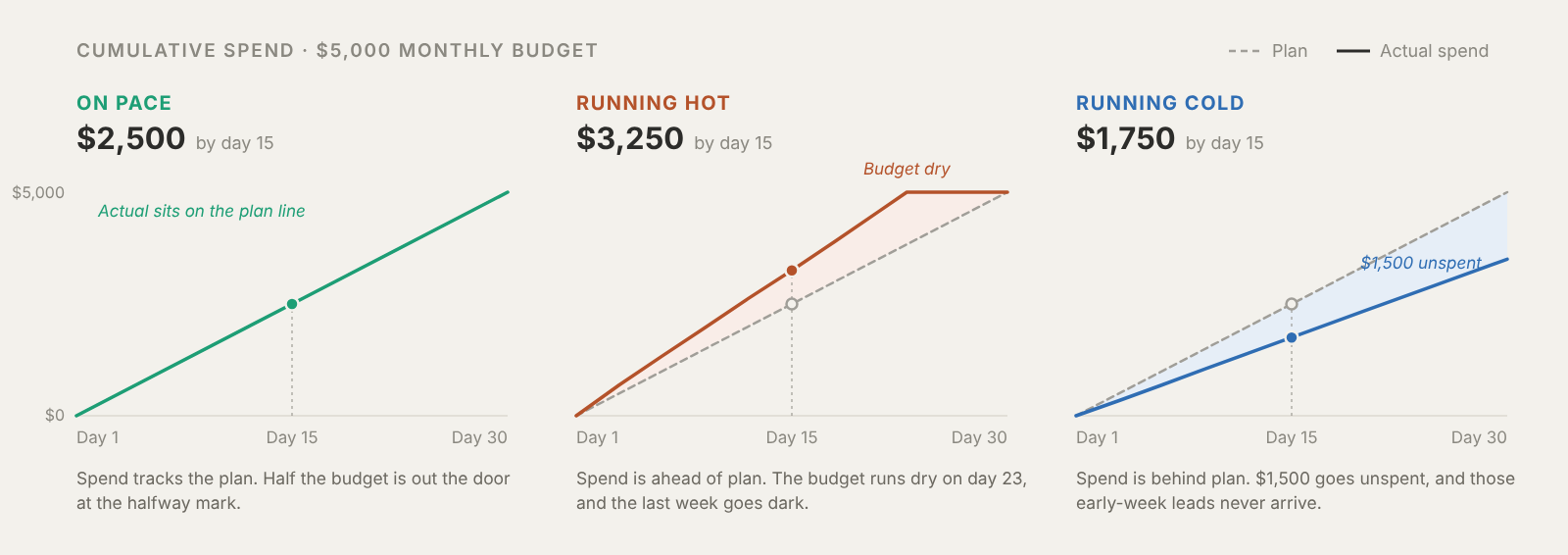
The same $5,000 budget in three states. On pace tracks the plan. Running hot exhausts the budget before month end and goes dark for the last week. Running cold leaves money unspent and early-week leads uncollected.
A $5,000 monthly budget can sit in any of these states, and most owners only learn which one when the statement arrives.
What Mispacing Costs at $5,000 a Month
At this budget level, small errors carry real weight. Overspend by 15% and you have spent an extra $750 you did not plan for. Underspend by 20% early and you either lose that reach or cram it into the final two weeks.
Larger companies have a media buyer checking pacing every morning. Most small businesses have an owner who checks when they remember. The gap between those two habits is where budget leaks.
You do not get underspent days back. The leads from week one are simply gone.
Spending on Schedule Is Only Half the Answer
A perfectly paced budget can still be wasted. The second question is effectiveness: what is each dollar producing?
For a small business, effectiveness usually comes down to two numbers. Cost per acquisition (CPA) is what you pay for each new lead or customer. Return on ad spend (ROAS) is how many dollars of revenue each ad dollar brings back.
Each platform reports these numbers in its own dashboard, by its own rules. Google might show a $42 cost per lead while Meta shows $28. That does not automatically mean Meta is working better. A lead from someone searching for your service may be far more likely to become a paying customer than a lead from a social scroll.
Few owners have time for that comparison on a Tuesday afternoon. So the budget split set in January stays put through October.
The Hours That Never Show Up on an Invoice
Here is the cost few owners count. A proper check means logging into each platform, matching date ranges, writing down spend and results, and comparing against the plan.
For a business running two or three platforms, that is easily 30 to 45 minutes. Done weekly, it adds up to two or three hours a month. Done daily, which is what pacing really requires, it becomes a part-time job nobody was hired to do.
So most owners check once a month, when the credit card statement arrives. By then, every decision is about last month.
How enso Handles Both Questions
enso connects to Google Ads, Meta, TikTok, Snapchat, Spotify, and Apple Ads and puts spend and results in one dashboard, updated automatically. Search, social, audio, and app store ads sit side by side on the same date range.
For pacing, enso tracks planned versus actual spend on each platform and sends an alert when spending drifts. You set the monthly plan once. If Google runs hot by the 10th or Meta stalls on the 4th, you hear about it that day, not at month end.
For effectiveness, the enso Learnings feature reads your campaign data and writes a plain-English summary of what changed and why it matters. A Learning might note that your Meta cost per lead rose 22% this week while Google held steady, compare both against your own targets, and suggest moving a specific amount of budget. You read it, decide, and get back to running the business.
Anomaly alerts flag sudden swings in CPA or ROAS, so a broken tracking pixel or a disapproved ad shows up as a notification instead of a mystery three weeks later. At $250 a month, enso costs 5% of a $5,000 media budget. One caught overspend can cover it.
What Changes When the Checking Is Done for You
The daily check takes five minutes instead of 45. The weekly decision about where to move money starts from a written analysis instead of a blank spreadsheet. The monthly review becomes a conversation about what to try next, not a reconstruction of what went wrong.
The bigger cost is the one no statement shows. Every hour spent digging through ad dashboards is an hour not spent with customers, quoting jobs, or training staff. Every day a campaign sits stalled on a disapproved ad is a day the phone does not ring. Neither loss is visible. Both are lost sales.
At $5,000 a month, this is not about convenience. It is about keeping your attention on the business, and knowing your ads are running the way you planned while there is still time to act.
Stop wrangling data. Start acting on it.
enso pulls your ad performance from every platform, analyzes it automatically, and tells you what to do next. Your team gets hours back every week.
More from Reporting
October 13, 2026
Google says one number. Meta says another. Your CEO wants to know which one is real. Here is how to...
October 2, 2026
A Senate campaign lost half its Facebook delivery without warning. The lesson for every team running...
June 29, 2026
enso turns scattered ad platform data into the analysis that tells your team what to do next, every...