
On the last weekend of September, half of a U.S. Senate campaign's Facebook ads stopped delivering. There was no warning and no explanation. Former Senator Sherrod Brown, running in Ohio's special election, told supporters in an email that the shutdown was not a decision his team made, and that they still did not know why it happened.
For about 48 hours, those ads reached nobody. The campaign had hoped to raise $50,000 from online ads that weekend. In-person early voting opens October 6, and a quarterly fundraising deadline was days away.
Brown called it the worst setback his campaign had seen all year.
Set the politics aside. This is a story every team running paid media should study, because the failure did not start with anyone on the team. It started upstream, on a weekend, without notice.
The Budget Was Safe. The Moment Was Not.
Ad platforms fail. Accounts get flagged, ads get pulled into review, and payment methods lapse. Delivery stalls for reasons nobody explains.
You do not control any of that. When ads go dark, the spend stops too, so the budget is not being wasted. What is being lost is harder to see: reach, conversions, donations, and time that a campaign with a fixed end date cannot buy back.
Data has a shelf life. Its value starts decaying the moment it becomes available, and a delivery failure is the most extreme version of that decay. The numbers showing the drop were accurate from the first hour. The only thing that mattered was how many hours passed before someone acted on them.
The Weekly Report Is the Wrong Smoke Detector
When a client asks "is it working," they are really asking three things. Is it running correctly, are the signals good, and is it worth continuing? The first question is the fastest to answer and the most expensive to miss.
Most teams answer it inside a weekly report, as a line item next to CPA and ROAS. Under that cadence, a campaign can run broken for 96 hours before anyone notices. Even a diligent account manager who checks every morning has gaps: twelve clients, three platforms, and weekends.
Run the timeline on a Friday night outage. An automated alert flags it within hours. A daily manual check that skips weekends finds it Monday morning, after roughly 60 hours dark. A weekly reporting cycle might not surface it until Thursday.
HOW LONG UNTIL SOMEONE KNOWS
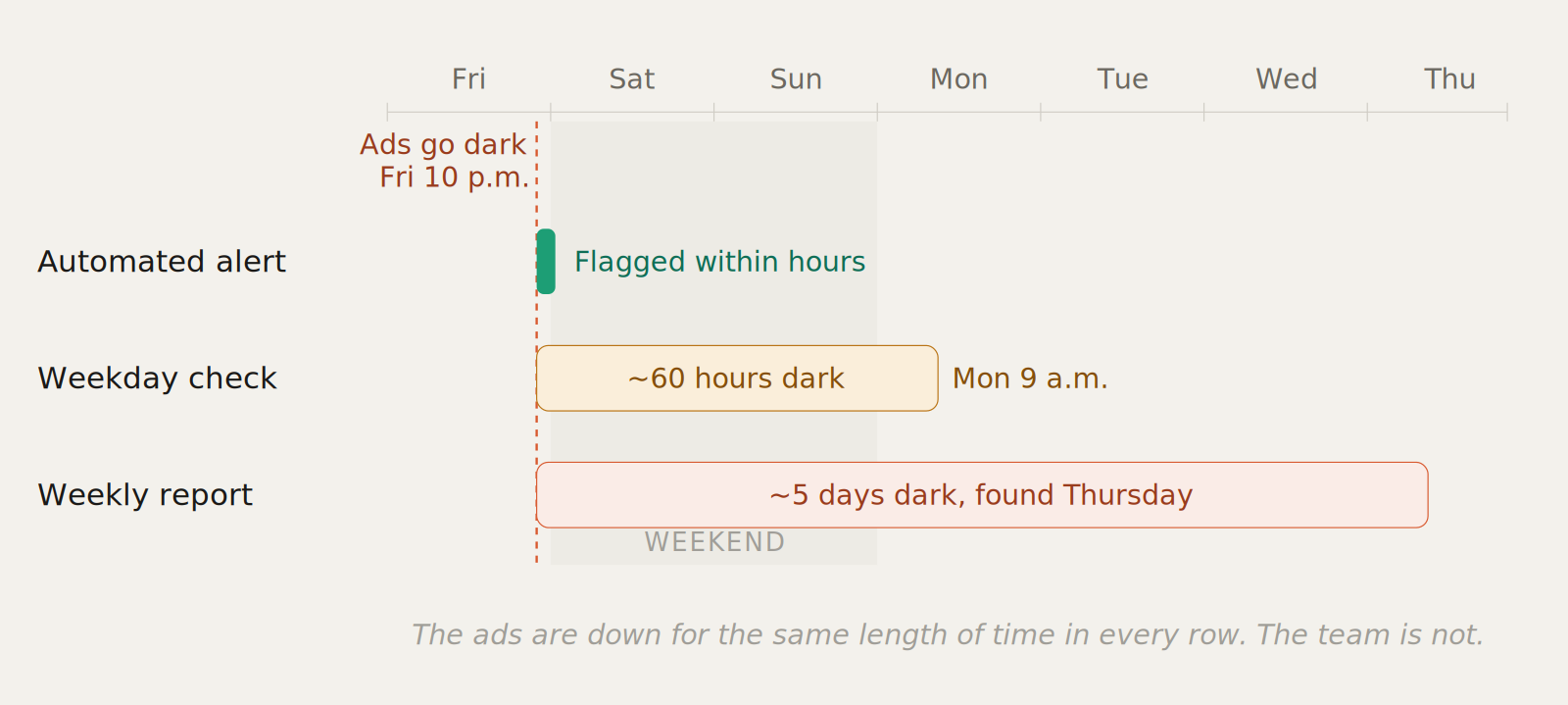
Illustrative scenario. A delivery failure that starts Friday night is caught in hours by an automated alert, after the weekend by a weekday manual check, and late the following week by a weekly reporting cycle.
The ads were dark the whole time in every version. The only difference is how long the team was dark too.
The Failure Is Visible in the Data Within Hours
A sudden drop in delivery is not subtle. Spend falls off plan and impressions collapse. The gap between planned and actual pacing opens fast and keeps widening.
The signal is sitting in the platform data almost immediately. The question is whether anyone, or anything, is looking.
PLANNED VS. ACTUAL SPEND
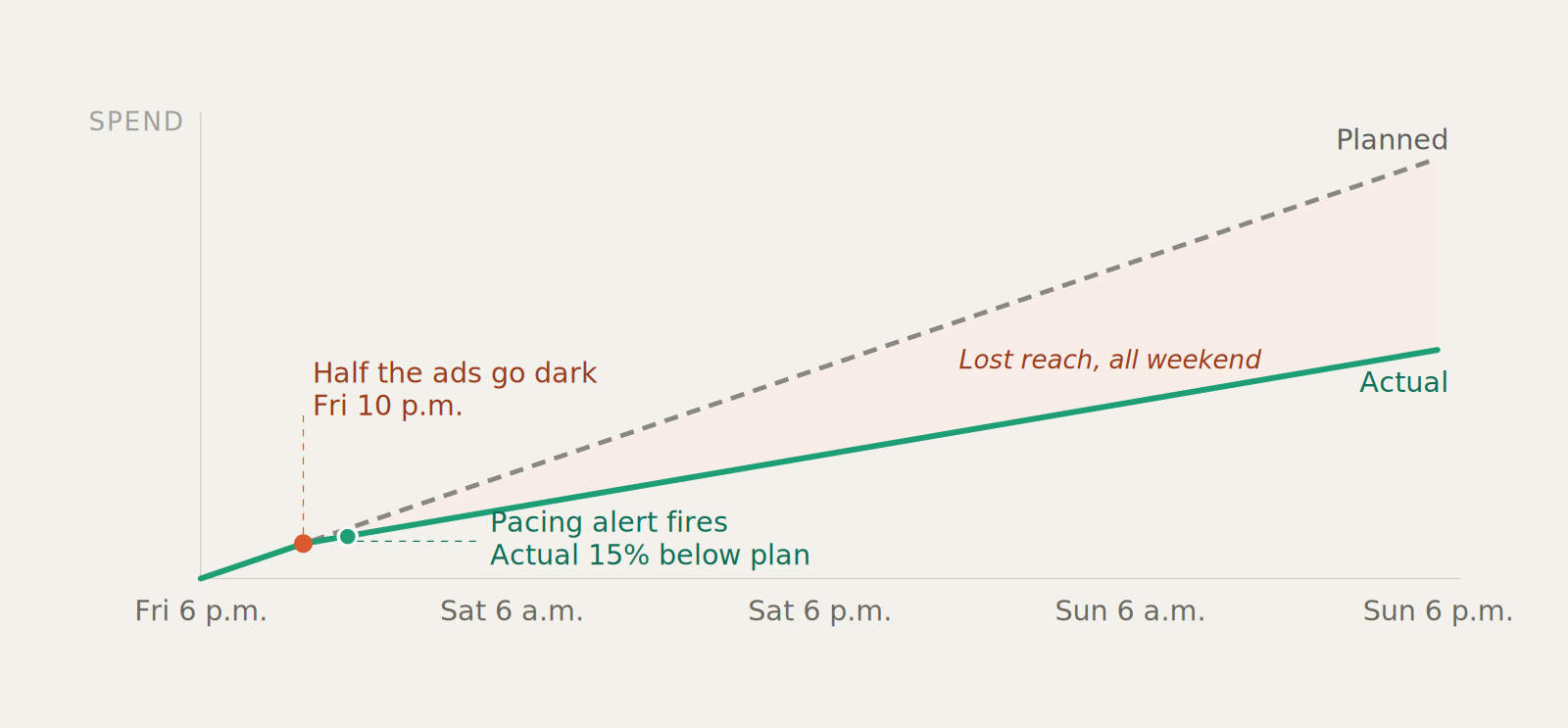
Illustrative pacing data. When half of active ads stop delivering, actual spend falls behind plan within hours. The gap is the reach that never happened, and it is visible in the data long before Monday.
Watching pacing curves across every account, every hour, including Saturday, is not a judgment call. It is monitoring. It does not require a human, and asking a human to do it is how outages last all weekend.
What enso Changes, and What It Does Not
enso cannot stop a platform from pulling ads. No reporting tool can. What enso changes is the gap between the failure and the first person who knows about it.
enso tracks planned versus actual spend and impressions for every connected account across Google Ads, Meta, TikTok, Snapchat, Spotify and soon Apple Ads. When pacing diverges from plan, an anomaly alert goes out automatically. Nobody needs to be logged in. They need a phone.
The next morning, the Learnings feature reads the account data and writes the plain-English analysis: what dropped, by how much, against which target, and what to check first. The account manager starts the day with the story already assembled.
Then the human does the work only a human can do. Escalate with platform support. Shift budget to channels that are still delivering. Call the client before the client calls you.
The judgment call stays with the human. The monitoring should not.
Hours Are the Cost
Every team running paid media will eventually have a weekend like this one. A platform will fail without explanation, and no amount of skill will prevent it.
The difference between a minor incident and a serious loss is detection time. In campaigns with a hard deadline, like an election, a product launch, or a holiday sale, lost hours do not come back. Budget can be moved. Time cannot.
The data showed the problem almost immediately. The question worth asking about your own accounts is simple: if half your ads went dark tonight, how long would it take you to know?
Stop wrangling data. Start acting on it.
enso pulls your ad performance from every platform, analyzes it automatically, and tells you what to do next. Your team gets hours back every week.
More from Reporting
November 6, 2026
For small businesses running paid search and social, two questions matter most: is the money going o...
October 13, 2026
Google says one number. Meta says another. Your CEO wants to know which one is real. Here is how to...
June 29, 2026
enso turns scattered ad platform data into the analysis that tells your team what to do next, every...